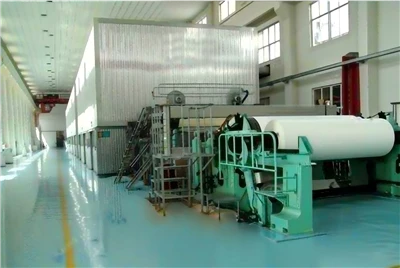

Key Knowledge Points of Paper Making Machine
The long-chain paper machine is the core equipment for producing corrugated board and corrugated base paper. The entire system comprises six major sections: pulp flow chamber, mesh section, pressing section, drying section, calendering section, and winding/rewind section. The coordinated operation of each process directly determines paper quality, production capacity, and manufacturing costs, making it a fundamental process in the papermaking industry.
The pulp box, as the first critical process in a paper machine, serves primarily to uniformly distribute paper material and generate a consistent pulp flow with precisely controlled width and stable velocity. Its design and operational stability directly determine the distribution of fibers and fillers, thereby ensuring the fundamental uniformity and overall quality of the paper product.
The slurry with a concentration of 0.4%-1.0% is sprayed onto the mesh surface and gradually dehydrated to form wet paper sheets with a dryness level of 16%-20%. The mesh configuration, in conjunction with the pulp flow chamber, determines the quality of paper formation; an optimal design effectively reduces fiber and filler loss while minimizing production waste.
The initial moisture content of formed wet paper pulp can reach up to 80%, making it prone to breakage and resulting in inferior paper quality when dried directly. The pressing section employs mechanical compression to increase the paper dryness to 30%-50%, while simultaneously eliminating web marks, enhancing surface smoothness and tightness, improving paper strength, and significantly reducing drying energy consumption.


The drying section consists of multiple sets of drying cylinders and represents the core process stage with the highest energy consumption and equipment costs in a paper machine. It heats and dries paper sheets to the standard moisture content using steam, optimizes the physical strength of the paper, and simultaneously performs processes such as sizing and dyeing, serving as the critical component for ensuring product compliance and controlling production costs.

The calendering section is installed at the rear end of the drying unit and consists of multiple friction-driven calender rollers. After calendering treatment, the paper exhibits significantly improved gloss, smoothness, and density, with corrected thickness variations ensuring uniform thickness and stable performance of the final product.
The paper winding machine is responsible for rolling paper sheets into standard paper rolls, with adjustable thickness tolerance, and is available in shaft-type or cylindrical types. The rewinding machine processes raw paper into customized finished paper rolls through tension control and longitudinal cutting, meeting downstream requirements such as printing; its key performance parameters include width, speed, and maximum roll diameter.